The Group of 20 foreign ministers' meeting hosted by Secretary of State Marco Rubio in Atlanta ended on Saturday, Oct. 31, 2026, without a joint communiqué, after two days of talks split over Russia's war in Ukraine, the U.S.-Iran conflict, tariffs and China's conduct in the South China Sea, the Associated Press reported via PBS NewsHour.
In place of a communiqué, the State Department issued a chair's statement listing U.S. priorities, including energy security, critical minerals and safe passage through the Strait of Hormuz. The customary "family photo" was canceled after European diplomats objected to standing beside Russian Foreign Minister Sergey Lavrov.
The meeting was the main diplomatic rehearsal for the G20 leaders' summit Trump will host in Florida in December. Rubio told reporters he would not "pretend" the group was close to "universally accepted solutions," according to the AP.
Key Facts
- When: Friday-Saturday, Oct. 30-31, 2026 (ET); chair's statement dated Oct. 31.
- Where: Atlanta, Georgia; the welcome reception was held at the Georgia Aquarium and Rubio's closing press availability at the Loews Atlanta hotel.
- Who: Host Marco Rubio; Russia's Sergey Lavrov; Poland's Radosław Sikorski (guest); Saudi Arabia's Prince Faisal bin Farhan; Turkey's Hakan Fidan; ministers of Australia, India and Japan.
- What: No joint communiqué; a U.S. chair's statement and a separate Quad press release instead.
- Absent: South Africa, a G20 member, was not invited; Ukraine, not a member, was also not invited; China sent a deputy foreign minister.
- Status: Concluded. Leaders' summit set for December in Miami.
- Key numbers: Quad pledge of more than $85 million for "trusted SI"; U.S. approval on Oct. 30 of a $2.1 billion sale of 500 Patriot interceptors to Ukraine.
What Happened
Rubio opened the ministerial at a welcome reception at the Georgia Aquarium on Oct. 30, calling it "a very productive start," according to the State Department transcript. He argued that "it is in the economic and national security interests of the United States that we are energy dominant."
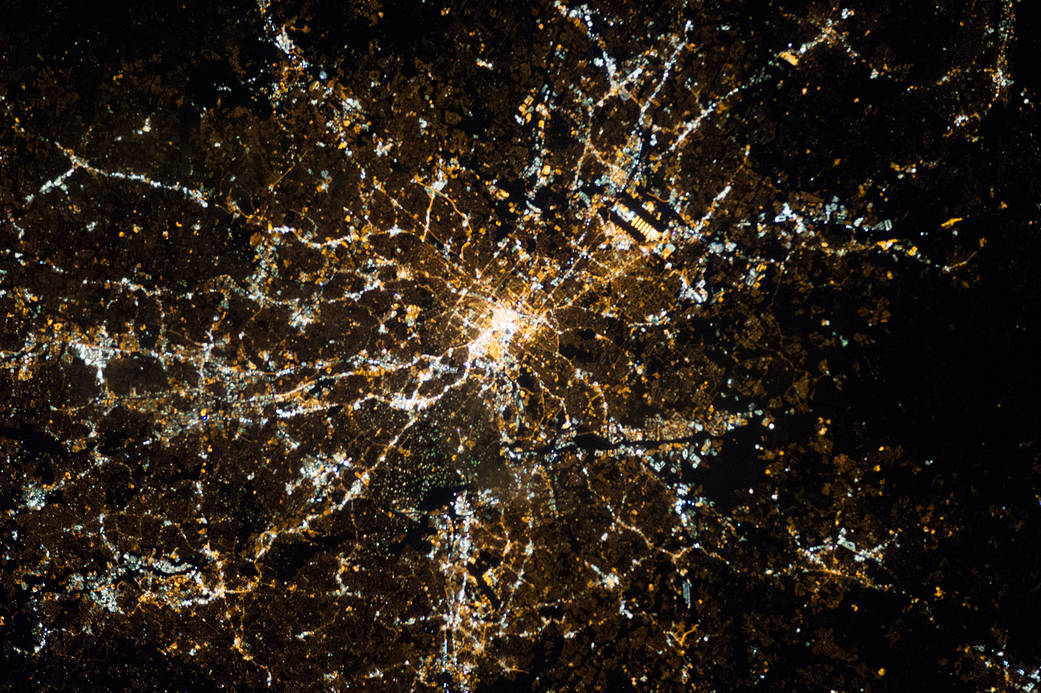
Atlanta, shown below from the International Space Station, hosted the talks ahead of the December summit.
The meeting was overshadowed before it began. Two U.S. officials, speaking anonymously, said Rubio canceled the group photo because he judged the controversy over Lavrov would be a distraction, after several European diplomats threatened to walk out, CBS Atlanta reported. German Foreign Minister Johann Wadephul told n-tv there would "definitely not be a family photo" with European partners and Lavrov, the Kyiv Independent reported.
Participants said Russia held firm on Ukraine and opposed Poland's admission to the G20. Lavrov said Moscow would not allow Ukraine to pose a "military threat to legitimate security interests of the Russian Federation," per the AP.
Polish Foreign Minister Radosław Sikorski, attending a G20 meeting as a guest for the first time, said he was not surprised. "We have wars going on, and we have participants in those wars around the table, so it's very difficult to agree on a common line," he said, according to the AP. The Seoul Economic Daily also reported that no joint statement or group photo resulted.
On Saturday, Rubio met counterparts from Australia, India and Japan, then chaired a final session on freedom of navigation in the Strait of Hormuz and the Red, Black and South China seas. At his closing press availability he said, "I don't know if a negotiated peace is achievable in Ukraine. That's what we're trying to find out," according to the State Department transcript.
"It is always important that the United States and Russia have communications at some level." — Secretary of State Marco Rubio, Oct. 31, State Department transcript
Rubio said he and Lavrov "didn't have a meeting. We spoke," describing a brief exchange about possible leader-level contact at the APEC summit. On Iran, he said talks "have actually never stopped" but declined to give a timeline.
Timeline
| Date/Time ET | Event |
|---|---|
| Oct. 21 | Russia says Washington has not confirmed its delegation details |
| Oct. 30 (Fri.) | U.S. scraps the group photo after European objections to Lavrov |
| Oct. 30 (Fri.) | Ministerial opens; Rubio meets Saudi and Turkish foreign ministers; welcome reception at Georgia Aquarium |
| Oct. 30 | State Department approves $2.1 billion Patriot interceptor sale to Ukraine |
| Oct. 31 (Sat.) | Quad press release; final navigation session; chair's statement; Rubio press availability |
| Dec. 14-15 | G20 leaders' summit in Miami, per the Rio Times |
Who's Involved
- Marco Rubio, U.S. secretary of state and chair: defended inviting Lavrov and Russian President Vladimir Putin, arguing that ending the war requires talking to both sides.
- Sergey Lavrov, Russian foreign minister: unyielding on Ukraine; Russia's foreign ministry said he would "promote Russian ideas" for a "multipolar world," per the Kyiv Independent.
- Radosław Sikorski, Polish foreign minister: guest participant whose country Russia opposes admitting.
- Johann Wadephul, German foreign minister: publicly refused a joint photo with Lavrov.
- Prince Faisal bin Farhan, Saudi foreign minister, and Hakan Fidan, Turkish foreign minister: met Rubio as the Iran conflict weighs on the Gulf.
- South Africa: not invited; spokesperson Phindile Kunene said "our nonparticipation is not voluntary," CBS Atlanta reported.
- China: represented by an unnamed deputy foreign minister rather than its top diplomat.
The Ground Picture
The chair's statement is notable for what it names. It identifies the "Straits of Hormuz" and Bab al-Mandab as geopolitical concerns and calls for "safe navigation and transit passage through international waterways," per the State Department text. It does not mention Ukraine or AI.
On energy, the statement backs "small modular and micro reactors" and says "every country is entitled to make its own sovereign choices." It calls critical minerals "crucial for energy security" and opposes using food trade "as a tool for economic or political coercion."
The Quad countries went further in their own document. The Quad joint press release pledges more than $85 million to expand "trusted SI" in the Indo-Pacific, launches an effort to map semiconductor supply-chain chokepoints, and commits $10 million in U.S. funding for mineral recovery in India and ASEAN countries. A footnote says that in Australia, India and Japan "Super Intelligence" refers to "artificial intelligence," reflecting a U.S. terminology change.
Geopolitical Players
Russia used the venue to show it is not isolated, a point sharpened by Trump's recent waiver of Graham Act sanctions. European members, led publicly by Germany, used the photo dispute to signal limits on engagement with Moscow.
Ukraine was absent but on the agenda. The State Department approved a potential $2.1 billion sale of 500 PAC-3 MSE interceptors on Oct. 30, though President Volodymyr Zelensky warned deliveries could begin "only in a few years," the Kyiv Independent reported. Earlier delays are covered in our report on stalled Patriot deliveries.
Saudi Arabia and Turkey were focused on Iran, with the AP reporting that U.S. officials told Middle East governments to prepare for possible renewed strikes after Tuesday's elections. India, represented by External Affairs Minister S. Jaishankar, was scheduled to join the Quad meeting, the Rio Times reported.
What It Means for the United States
Benefits and opportunities
- Washington set the agenda: energy, minerals and navigation in Hormuz appear in the chair's statement, framing the Miami summit around U.S. economic priorities.
- The Quad commitments on chip chokepoints and mineral recycling aim to reduce reliance on any single supplier, a goal aimed largely at China.
- Keeping a channel to Moscow, as Rubio argued, preserves options for Ukraine diplomacy before APEC.
Risks and dangers
- Failing to produce a communiqué at a U.S.-hosted meeting raises doubts about consensus at the leaders' summit.
- Excluding South Africa drew objections from other members and could cost goodwill in Africa and the Global South.
- Analysis: Visible friction with European allies over Lavrov could give Moscow a propaganda win and complicate Western unity on Ukraine.
Get the full Intel Briefing. Pro Truth Seeker members get members-only analysis of the road to the Miami G20 summit and the daily Intel Briefing. Become a member.
What's Next
- Nov. 3: U.S. midterm elections, after which Iran strike options are expected to reach the president.
- APEC (China): Rubio said Russia raised possible leader-level contact there.
- December: G20 leaders' summit hosted by Trump in Florida; whether Putin attends is unclear.
For more, subscribe to the Ecker Dispatch and watch Ecker Geopolitics.
Sources
- PBS NewsHour (AP): G20 foreign ministers end Atlanta meeting without consensus on key issues (Oct. 31, 2026)
- U.S. Department of State: G20 Chair's Statement, G20 Foreign Ministers' Meeting (Oct. 31, 2026)
- U.S. Department of State: Secretary of State Marco Rubio at a Press Availability (Oct. 31, 2026)
- U.S. Department of State: Secretary Rubio at the G20 Foreign Ministers' Meeting Welcome Reception (Oct. 30, 2026)
- U.S. Department of State: Quad Joint Press Release on Economic Prosperity and Security (Oct. 31, 2026)
- Seoul Economic Daily: G20 Foreign Ministers End Talks Without Joint Statement or Group Photo (Nov. 1, 2026)
- CBS Atlanta: U.S. cancels G20 group photo in Atlanta after diplomats object to posing with Russia's Lavrov (Oct. 30, 2026)
- Kyiv Independent: G20 family photo allegedly canceled over Russian presence (Oct. 30, 2026)
- Kyiv Independent: US approves $2.1 billion Patriot missile sale to Ukraine (Oct. 30-31, 2026)
- The Rio Times: India's foreign minister joins Atlanta G20 (Oct. 28, 2026)
- NASA: Atlanta Shines at Night (image, public domain)